Sitting, Seeing, Sketching
by Bruce Petrie Jr., Board of Trustees Chair, Cincinnati Art Museum
9/8/2026
Frequently we hear people say, “I’d like to learn to draw.” How to get started? We’ve coined the term “sketchery” to mean a work made by human hand, not AI, to practice drawing.
Sketchery’s tools are simple: a pencil and sketch pad. Simplifying your tools encourages; too many art supplies piled on at once can be intimidating. It’s not about more supplies; it’s about more observation.
Since AI is a non-human tool that makes pictures not entirely of your creation, there’s never a pictorial equivalency between human and robotic picturing. A picture you create is uniquely, humanly yours, both in the making and the outcome; a machine’s product isn’t.
Our mantra in sketchery drawing is “simplify.” A one-dollar graphite pencil has the virtue of humility. An ambitious 25-dollar tube of French ultramarine oil paint with too many expectations is another story.
Equipped with the simplest of tools, our goal at first is not learning to draw. Yes, that’s right, our goal is to unlearn a thing or two. Unlearning involves real seeing. Making free, open space in your day and yourself to observe anew.
Before we put pencil to paper, we look at the object of interest and draw it … with our eyes. We sit, quiet down, put the phone aside. We unlearn the temptation of screen time and news feed for just a few minutes. We notice our morning coffee mug on the stone patio. Sketchery thrives on noticing everyday things as they are here and now. Sketchery says this is the way I found it to be.
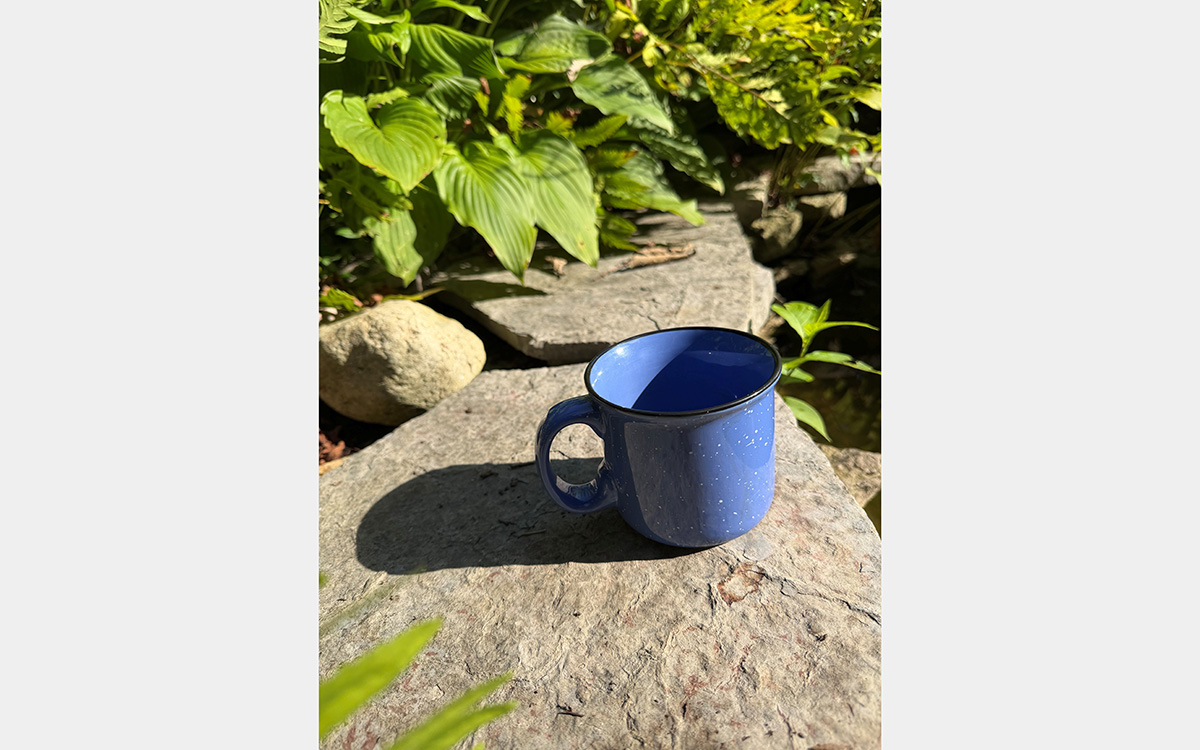
We unlearn for a minute the words “coffee mug.” We go from verbal to nonverbal. It’s not a cup of coffee anymore. It’s form, line, shape, light, shadow, color.
Our eyes take in the view, following a line around the outline of the “cup.” We notice a negative space where the handle is. The morning is casting a light and shadow design. We walk our eyes at the margins where light meets shadow. The cast shadow on the stone has a shape. We see the cup as a light and shadow pattern. And it constantly changes as the light does. The cup is a sundial.
It’s also our coffee, so we take a sip, put the cup back, noticing it’s now a changed pattern of light and shadow.
So now we’re ready to jump in with pencil and sketchpad. Keep in mind the mantra of simplify. This applies to our marks, our lines. Using as few lines as you can, draw only four things: the cup outline, the space between the handle and cup, the cast shadow margin on the stone, and the line on the cup where light meets shadow. That’s it!
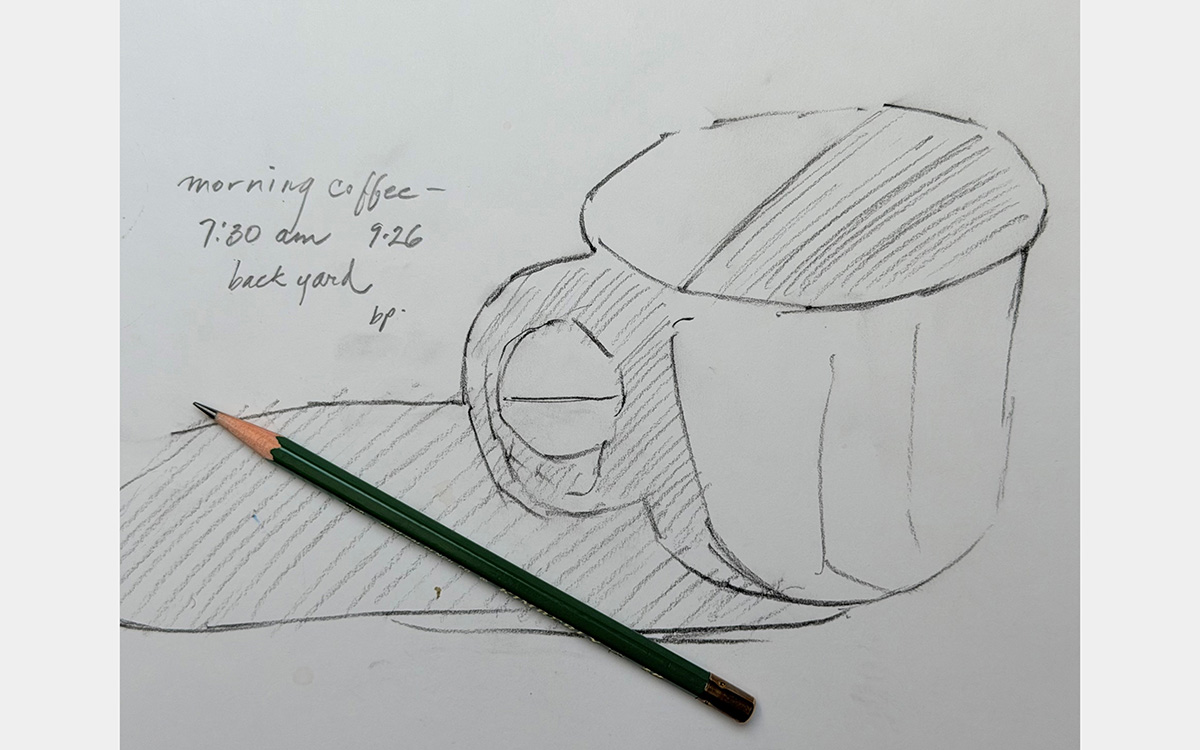
If you wish, you can add some shading but keep it simple with light cross-hatching diagonal lines.
Notice we didn’t include an eraser. That’s to avoid the temptation to scrub away at, to correct what you think is wrong. No need to dwell on what you think are mistakes, right? All marks in sketchery are A-okay. We can remark but leave the first ones there. None other than Leonardo left the trail markings in his drawings, fascinating telltales of his eye travels, showing us he started the line there, but as he saw more deeply or the light changed, he adjusted his line of travel like a ship on a visual adventure.
Finally, save your sketchery. See the progress you’ll make if you make a habit of practicing this simple exercise in say 15 minutes or so of sitting, seeing and sketching. You’ll be amazed at what there is to unlearn as the aesthetic experience of sketchery silently with a smile draws you into a new way of seeing.
Related Blog Posts

Cincinnati, OH 45202
Toll Free: 1 (877) 472-4226
Museum Hours
Museum Shop
Terrace Café
Library
Cincinnati Art Museum is supported by the tens of thousands of people who give generously to the annual ArtsWave Campaign, the region's primary source for arts funding.

Free general admission to the Cincinnati Art Museum is made possible by a gift from the Rosenthal Family Foundation. Exhibition pricing may vary. Parking at the Cincinnati Art Museum is free.
Generous support for our extended Thursday hours is provided by Art Bridges Foundation’s Access for All program.

General operating support provided by: