The Historian, the Museum, and the Progress of American Arts & Science
by Bruce Petrie Jr., Board of Trustees Chair, Cincinnati Art Museum
6/10/2026
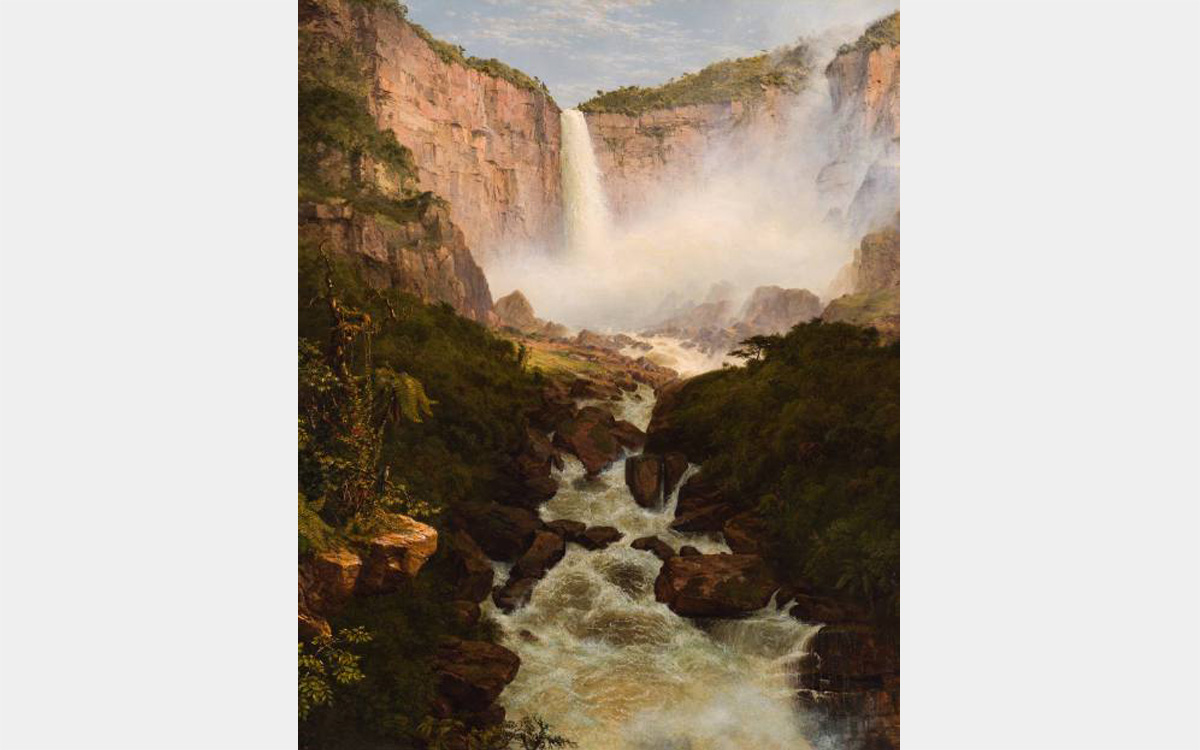
Frederic Edwin Church (American, 1826–1900), The Falls of Tequendama, Near Bogotá, New Granada, 1854, oil on canvas, The Edwin and Virginia Irwin Memorial, 1971.30
On June 7, 2026, America lost one of our nation’s leading historians of the Revolutionary Era, Gordon Wood, age 92. There is poignancy that one of America’s finest scholars on the American Revolution should pass on the eve of the 250th anniversary of the signing of the Declaration of Independence. It reminds us of Thomas Jefferson and John Adams dying on the same day on July 4, 1826, the 50th Anniversary of the Declaration. A winner of the National Humanities Medal, Professor Wood came about as close as one can to “knowing” founders like Adams and Jefferson and passing that knowledge on to countless others.
As an American history major at Brown, I met Professor Wood in the 1970s and eagerly took every class he taught, among them one titled “The Radicalism of the American Revolution.” Professor Wood would go on to win the Pulitzer Prize for his groundbreaking book of that same title. History came alive, real and credible, by a historian who dug deep into primary, original sources from centuries ago.
Over the years, we kept in touch. On leave from Brown, Professor Wood taught American constitutional history at Northwestern Law School in Chicago. I had already graduated from Northwestern Law and was a practicing lawyer at the time Professor Wood was at Northwestern. However, his constitutional scholarship continued to inspire us. He used to say that American Constitutionalism was the “glue” that held America together. I agreed with that then and still agree with that today, teaching the Constitution to undergrads at Miami University and the University of Cincinnati. Learning American history grows one generation to the next, “for ourselves and our posterity,” like passing a relay baton. My daughter, son, and son-in-law learned some American history at Brown.
What interested me, in particular, was the Constitution’s Arts & Science Clause which states that one of the Constitution’s purposes is to promote the progress of the arts and sciences. This links to freedom of thought, conscience, expression, and speech: the life blood of the arts and sciences. The American Enlightenment era (1750–1820) recognized that the arts and science are not separate, but are necessarily joined modes of thought, learning, and discovery. The arts and sciences depend on each other. Science without humanity can lose its way or worse. The arts without science can lose its ways of discovery and knowledge.
The United States Constitution does not mention the word democracy, but it does mention the word “arts.” A new republic of, by, and for the people depends on informed citizenship. Under an old-world monarchy, citizens didn’t need to think for themselves and be informed; they just needed to obey what the boss demanded.
American art museums since the nineteenth century and beyond are connected to the constitutional arts and science purpose of an American republic with an informed citizenry. The museums of America help serve the best hopes and aspirations of self-governance by promoting the dignity and value of human creativity and of all the people.
Professor Wood was a scholar not only of history but of historiography, or the writing of history based on critical examination of sources. He focused his research on primary source materials and artifacts. By rolling up his sleeves and digging into newspapers, paintings, letters, writings, pictures, drawings, maps, and so on from the Revolutionary era, his historiography allowed the past to speak for itself through artifacts. Artifacts are evidence. It’s good to remember how important artifacts are. Without artifacts, opinions about all sorts of things can float in the air of social media without any substantiation in fact.
Professor Wood warned against presentism, the tendency to distort the past through the lens of the present. It mistakenly attributes twenty-first-century thoughts, motives, culture, and context to people who lived long ago in different times, contexts, and circumstances. Presentism doesn’t let the past speak in its own past-ness. That’s why artifacts, as evidence of the past, are valuable. We get at the true facts of the past rather than the past written in the way people today want the past to look like, for political, financial, social, or other motives.
Gordon Wood and other distinguished American historians, past and present, have done a great service with and for American museums, including those like the Cincinnati Art Museum, founded in 1881. American art museums thrive on first-rate depth of scholarship and knowledge of American and global history.
Amid the sadness of losing a great historian, we can celebrate their contribution and legacy of learning. We are a better museum, and a better America, for it.
Related Blog Posts

Cincinnati, OH 45202
Toll Free: 1 (877) 472-4226
Museum Hours
Museum Shop
Terrace Café
Library
Cincinnati Art Museum is supported by the tens of thousands of people who give generously to the annual ArtsWave Campaign, the region's primary source for arts funding.

Free general admission to the Cincinnati Art Museum is made possible by a gift from the Rosenthal Family Foundation. Exhibition pricing may vary. Parking at the Cincinnati Art Museum is free.
Generous support for our extended Thursday hours is provided by Art Bridges Foundation’s Access for All program.

General operating support provided by: