Alfred Sisley's "Moret at Sunset"
by Lauren M. Caskey, Ph.D., Curatorial Fellow in European Art
7/1/2026
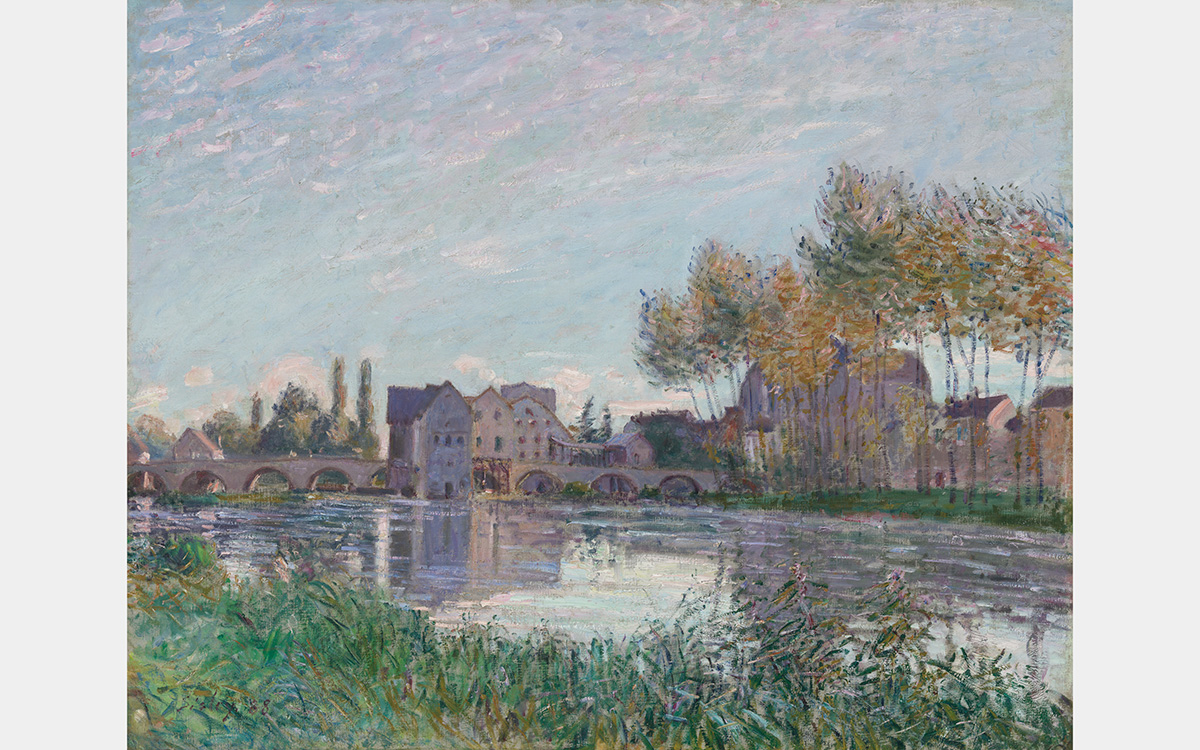
Alfred Sisley (French, 1839–1899), Moret at Sunset, 1888, oil on canvas, Gift of Mr. and Mrs. Albert P. Strietmann, 1953.329
Alfred Sisley (1839–1899) was born in Paris to an English family of business owners working in the international textile trade. Around age 18, Sisley began to frequent London’s art museums, and by the autumn of 1862, he enrolled in the Paris atelier of Swiss painter, Charles Gleyre (1806–1874). Sisley’s soon-to-be Impressionist contemporaries Auguste Renoir and Frédéric Bazille were already students of Gleyre, and Claude Monet would briefly attend classes that following year.
The young artists traveled throughout Paris’s surrounding regions and painted sites such as La Grenouillère and the Forest of Fontainebleau plein air (outdoors). Sisley, unlike others in the group, focused almost exclusively on landscapes. His paintings of remote locations in France are “prosaic” in their simplicity. When describing his work, Sisley emphasized the need to have a diverse treatment of paint application—particularly as it relates to light and shadow. He preferred to begin a landscape by painting the sky first as he believed that it was the key factor in capturing a scene’s mood.
In Moret at Sunset, Sisley demonstrates his careful observation of light and color on the town’s riverbank and medieval architecture. Here, he captures the evening glow of sunset by contrasting warm oranges and pinks on the sides of buildings against the cool blues and greens of the water, grass, and trees. In an 1892 letter, Sisley writes, “I have been in Moret and the surrounding region for nearly twelve years. It is Moret, amid this dense nature, with its tall poplars and the beautiful, transparent, changing waters of the Loing… that my art has undoubtedly developed most… I will never really leave this little place that is so picturesque.”
Related Blog Posts

Cincinnati, OH 45202
Toll Free: 1 (877) 472-4226
Museum Hours
Museum Shop
Terrace Café
Library
Cincinnati Art Museum is supported by the tens of thousands of people who give generously to the annual ArtsWave Campaign, the region's primary source for arts funding.

Free general admission to the Cincinnati Art Museum is made possible by a gift from the Rosenthal Family Foundation. Exhibition pricing may vary. Parking at the Cincinnati Art Museum is free.
Generous support for our extended Thursday hours is provided by Art Bridges Foundation’s Access for All program.

General operating support provided by: