American Scenes
by Franck Mercurio, Publications Editor
7/3/2026
The 250th anniversary of the signing of the Declaration of Independence is upon us, and the Cincinnati Art Museum is celebrating (in part*) by highlighting works by American artists in the museum’s collection.
Enthusiasts of American history describe Boston and its environs as the "birthplace of the American Revolution." The city in the late 1700s was a rough-and-tumble seaport of some 16,000 people with vital trading links to Great Britain, the Caribbean, southern Europe, and the other American colonies. Boston along with other Massachusetts seaports—including Glouster, Nantucket, and New Bedford—became favorite subjects of artists who painted the towns’ harbors, ships, and seascapes.
Swipe through the slideshow below to take a look at three artworks representing New England seaports in CAM’s collections. Each was created by a different American artist, and each reflects the distinct artistic style of its day.
*This fall, the Cincinnati Art Museum continues its celebration of America’s 250th birthday, presenting three exhibitions featuring three American artists with ties to Cincinnati and southern Ohio: Nancy Rexroth, Charley Harper, and Terence Hammonds.
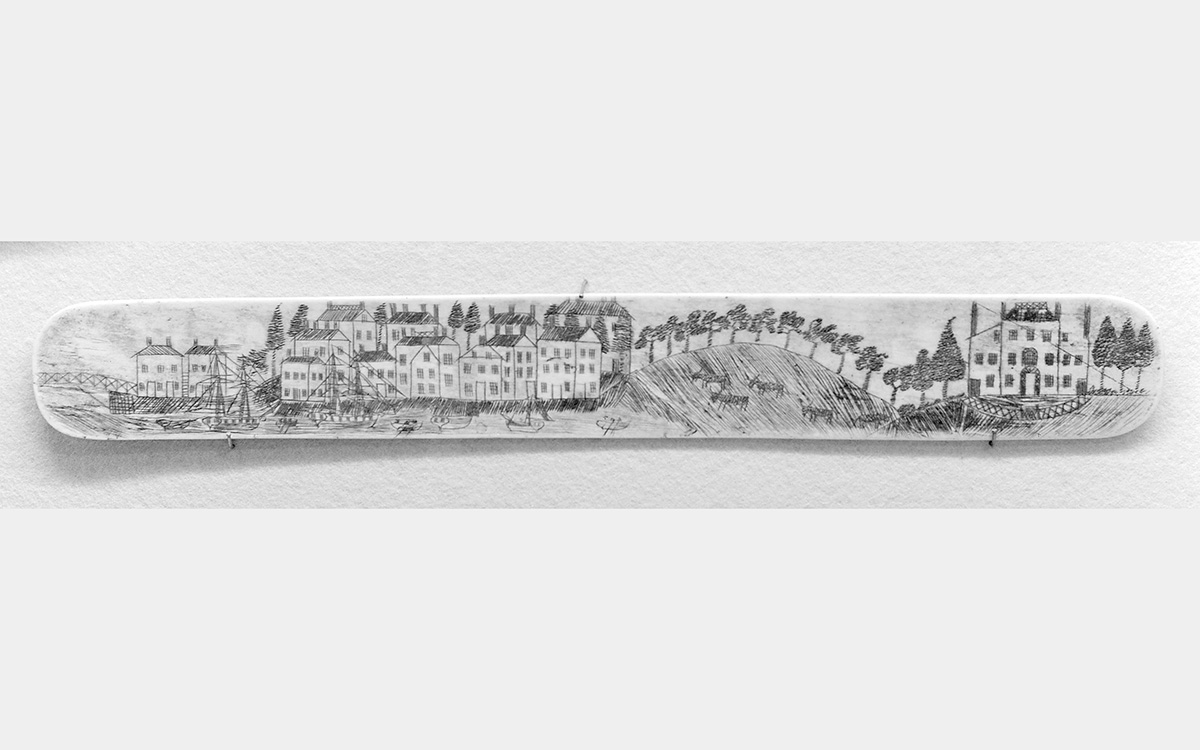
Buskin or Corset Stay, early 19th century, whale bone and ink, Carol R. Guggenheim Memorial Fund, 1958.421
The sailors who made scrimshaw—engravings on whale bone, walrus ivory, and baleen—were whalers, seamen who traveled around the world on extended voyages to hunt whales and other sea mammals. Whalers experienced long days at sea without much to do in between hunts; one way they passed the time was to produce scrimshaw objects, like this corset stay.
An unnamed whaler-artist engraved this scene of a harbor town onto a polished piece of whale bone. As a corset stay, it's an intimate object—worn in a sleeve sewn onto the corset's front, close to the wearer's heart. The artist most likely made this one for his wife or sweetheart; the depicted seaport might even represent the sailor’s hometown.
The artist created the image using a sharp metal tool, something we might recognize today as an awe with a thin tip. After the maker engraved the image into the surface of the bone, they filled in the lines with ink. This depiction of the seaport town (with its tall buildings huddled closely together), harbor (with its boats of different types and sizes), rural landscape (with cattle grazing on a wooded hill), and manor house (with its fenced-in yard, side wings, and many windows) captures an American scene of the early 1800s, created in a folk-art style.
To hear more, listen to a description on Bloomberg Connects.
On view in Gallery 219.
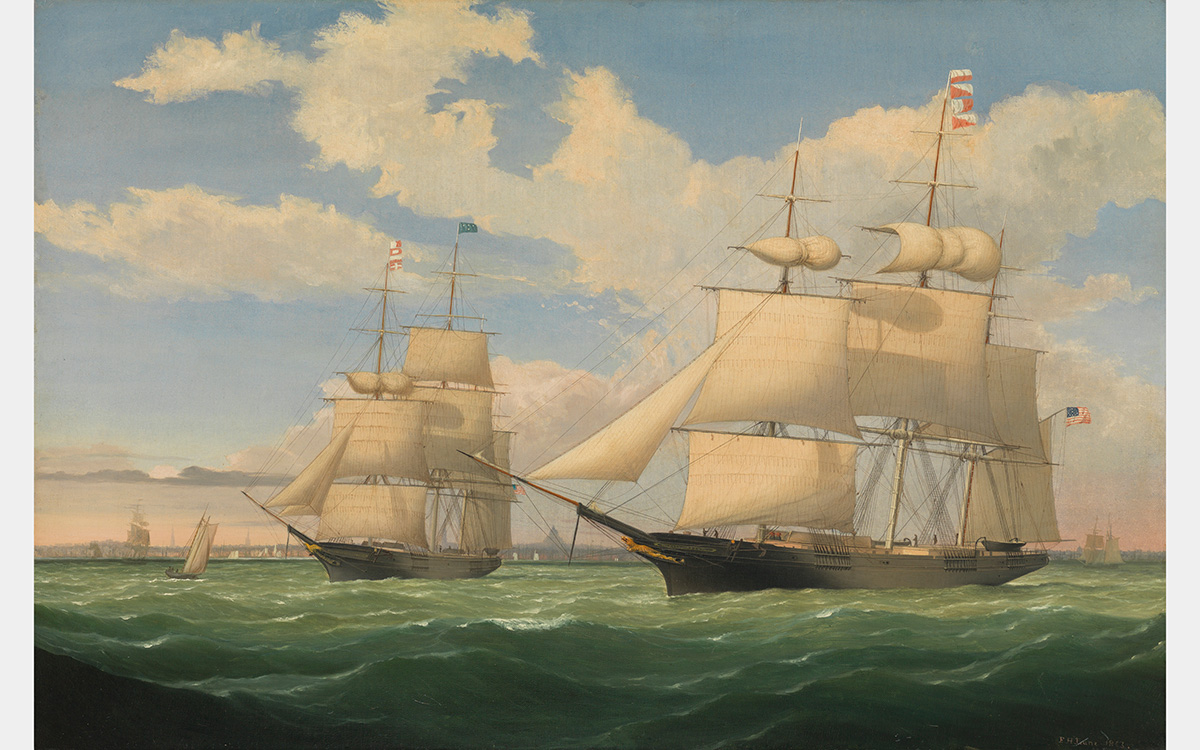
Fitz Henry Lane (American, 1804–1865), The Ships “Winged Arrow” and “Southern Cross” in Boston Harbor, 1853, oil on canvas, The Edwin and Virginia Irwin Memorial, 1971.31
Artist Fitz Henry Lane (1804–1865) grew up in the New England seaport of Glouster, Massachusetts. The son of a sailmaker, Lane was intimately familiar with the sailing ships of his day from the time he was a boy. As a young man, he moved to Boston and apprenticed himself to a lithographer; it was there that Lane received his training in art making. A few years after learning the trade of lithography, he took up painting and soon became a sought-after artist known for his seascapes and ship portraits, often winning commissions from ship owners and captains.
Lane was an active follower of the "Luminism" movement of the early-nineteenth-century when American artists captured a kind of glowing quality of light—or luminosity—in their landscapes and seascapes. In The Ships "Winged Arrow" and "Southern Cross" in Boston Harbor (a double ship portrait, commissioned by the ships' owner) you can see how Lane handles the illusion of sunlight penetrating the ocean's surface; he paints the waves in darker tones in the foreground and then gradually transitions to lighter tones as the ocean recedes towards the middle ground, before switching to darker tones again in the background. Lane also captures an atmospheric daylight around the ships, and a hazy image of Boston, far in the distance, spanning the length of the horizon line.
In this American scene, Lane reflects the trade, activity, and prosperity of a growing Boston in the early 1800s.
On view in Gallery 217.
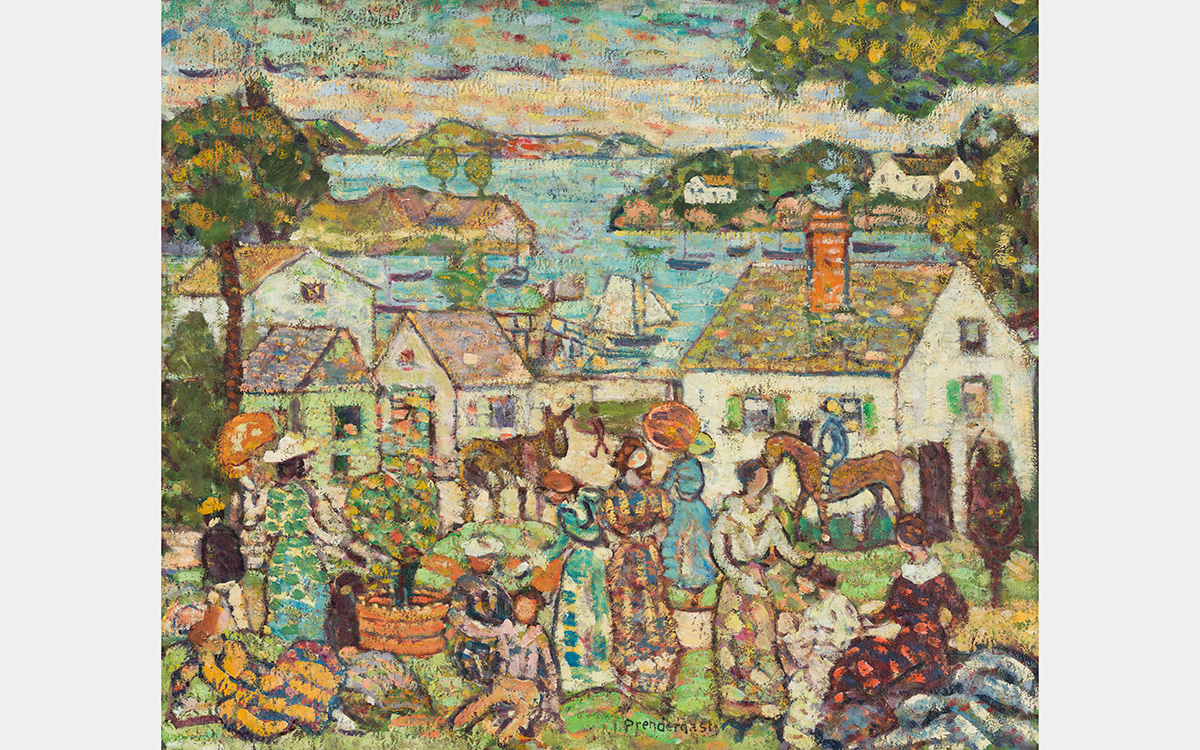
Maurice Prendergast (American, 1859–1924), New England Harbor, circa 1919–23, oil on canvas, The Edwin and Virginia Irwin Memorial, 1959.51
Maurice Prendergast (1859–1924) was born in the Canadian province of New Foundland and moved to Boston with his family as a child. He received his formal art training in Paris in the 1890s and was greatly influenced by French Post-Impressionism. The movement encouraged artists to create their own individual expressions and emphasized strong structural compositions, bold use of color, and flatness of the picture plane. (Think of artwork by the likes of Van Gogh, Cezanne, Gaugin, and Seurat.)
In New England Harbor, rather than creating an illusion of depth and three-dimensionality using refined brushwork—standard practice for artists during much of the 1800s—Prendergast painted his canvas with mosaic-like patterns, brilliant colors, and textured surfaces. In the picture, the artist relegated the harbor and bay to the background, almost as after-thoughts; instead, he captured the vibrancy of this American scene by placing the townspeople up front, focusing on their colorful clothing and painting the figures in an almost abstract way.
On view in Gallery 212.
Related Blog Posts

Cincinnati, OH 45202
Toll Free: 1 (877) 472-4226
Museum Hours
Museum Shop
Terrace Café
Library
Cincinnati Art Museum is supported by the tens of thousands of people who give generously to the annual ArtsWave Campaign, the region's primary source for arts funding.

Free general admission to the Cincinnati Art Museum is made possible by a gift from the Rosenthal Family Foundation. Exhibition pricing may vary. Parking at the Cincinnati Art Museum is free.
Generous support for our extended Thursday hours is provided by Art Bridges Foundation’s Access for All program.

General operating support provided by: