Eternal Spring: Painted Flowers and Evocative Meanings
by Amanda Martin-Parras Curatorial Assistant, European Paintings, Sculpture, and Drawings
3/20/2026
As the flowers surrounding the museum beautifully bloom this spring, floral imagery enlivens the galleries inside. Early modern Netherlandish and Flemish painting plucked the floral subject not only for its aesthetic quality, but its symbolism and evocativeness.
In the late 1400s, flowers gained religious significance as they decorated ornate Books of Hours: the rose as Virgin Mary, with its thorns representing sins; the white rose for purity and chastity; the red rose for Christ’s Passion; the white lily for virginity; the iris as royal, signifying Mary as Queen of Heaven; and the columbine, violet, daisy, pansy, and strawberry plants with their tripartite leaf arrangements evoking Christianity’s Holy Trinity.
In August 1606, Jan Brueghel the Elder wrote to Federico Borromeo about his Vase of Flowers with Jewel, Coins and Shell (1606), “I believe that so rare and varied flowers never have been finished with similar diligence; in winter this painting will make a beautiful sight. A few of the colors are very close to nature.”
Many of these dynamic bouquets could never have existed in real life as artists combined flowers from different seasons and regions. In the 1600s, the expression Ars longa, vita brevis (art is long, life is brief) was fundamental to the Dutch still-life, or naer het leven (painting from life).
In 1628, Borromeo wrote about the scent of Brueghel’s painted blossoms, "Then when winter encumbers and restricts everything with ice, I have enjoyed from sight — and even imagined odor, if not real —fake flowers...expressed in painting."
Take a look at the paintings in the slideshow below. Do the flowers of artists Joos van Cleve, Willem van Aelst, and Isaak Soreau have the same effect?
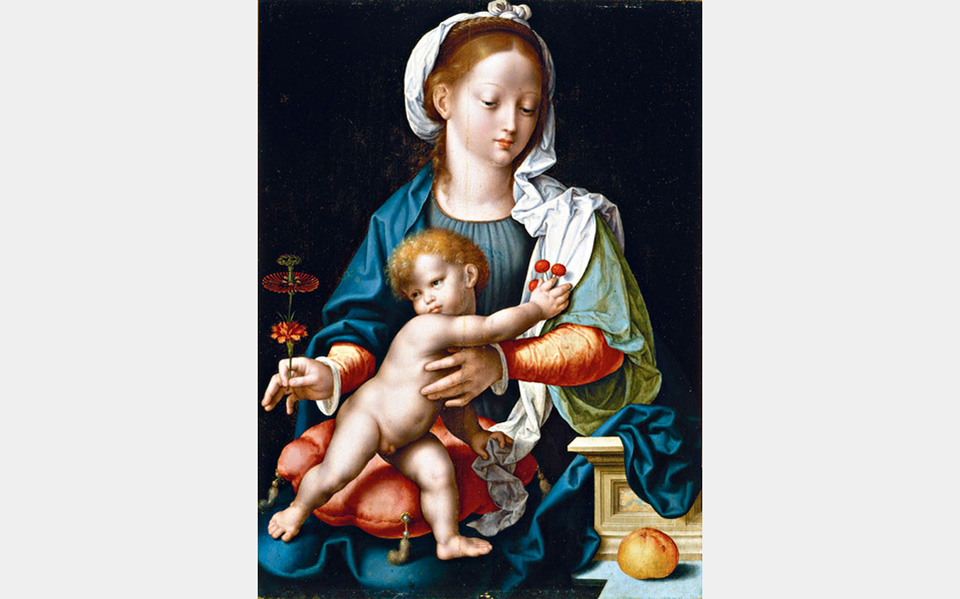
Joos van Cleve, Madonna and Child, 1530–1535. Oil on panel. Centennial Gift of the Cincinnati Institute of Fine Arts. 1981.130.
In Gallery 204, Joos van Cleve’s Madonna and Child (1530–35) depicts a traditional religious scene yet is most appealing for its extraordinarily fine fruits and florals—Madonna carefully clasping a stem between forefinger and thumb. The Child elegantly contorts his body away from the carnation, as it signifies Christ’s passion. The bunch of cherries in his hand alternatively act as the Fruit of Paradise or blood of Christ, a heavenly reward for a pure life.
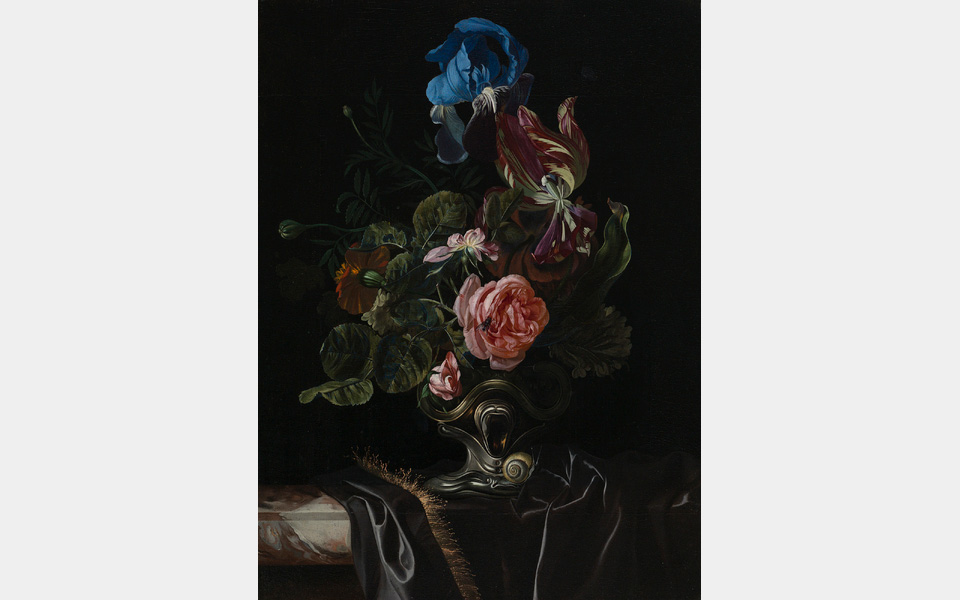
Willem van Aelst, Flower Still Life, circa 1663. Oil on canvas. Bequest of Mrs. L.W. Scott Alter, 1988.149
Ensconced in the adjacent Gallery 205, Willem van Aelst’s Flower Still Life (circa 1663) comprises large open flowers springing towards the viewer, closed buds receding into the background, tiny fauna—see the detailed fly and snail, and cascading drapery catching the light.
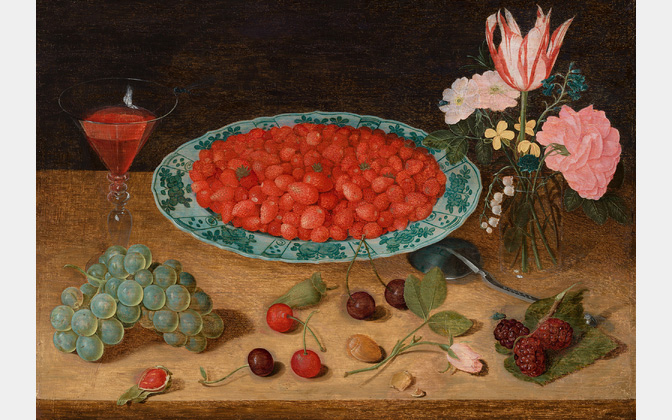
Isaak Soreau, Still Life with Dish of Strawberries, early 1630s. oil and tempera on panel. Gift of Mrs. Robert McKay, 1960.496.
Though not a flower, the wild strawberry (fragaria vesca) is likewise significant, appearing in medieval Books of Hours, Shakespeare’s Othello (1603), and Northern European still lives. Similar renditions place the strawberries in a Wan-Li bowl (blue-and-white Chinese porcelain bowls made under the Ming Dynasty), much resembling artist Isaak Soreau’s Kraak porcelain depicted in Still Life with Dish of Strawberries (early 1630s) in Gallery 205. The strawberry was associated with transient pleasure (kortstondig genot), as was Kraak ware—representing a newfound wealth in the Dutch Republic. And like the bouquets, fruit too would rot and decay.
Related Blog Posts

Cincinnati, OH 45202
Toll Free: 1 (877) 472-4226
Museum Hours
Museum Shop
Terrace Café
Library
Cincinnati Art Museum is supported by the tens of thousands of people who give generously to the annual ArtsWave Campaign, the region's primary source for arts funding.

Free general admission to the Cincinnati Art Museum is made possible by a gift from the Rosenthal Family Foundation. Exhibition pricing may vary. Parking at the Cincinnati Art Museum is free.
Generous support for our extended Thursday hours is provided by Art Bridges Foundation’s Access for All program.

General operating support provided by: