Homage to an Artist's Notes
by Julie Ribits, Head of Conservation
1/13/2026
It’s not often that the verso (or back) of a painting is featured when installed in a gallery, but if I had to choose one to show our visitors, it would likely be Josef Albers’ Study to Homage to the Square/From Inside. One of more than 1000 works in Albers’ Homage to the Square series completed between 1950 and the artist’s death in 1976, From Inside features three nested squares in varying shades of blue-green, showcasing both his understanding of geometric abstraction and masterful manipulation of color theory.
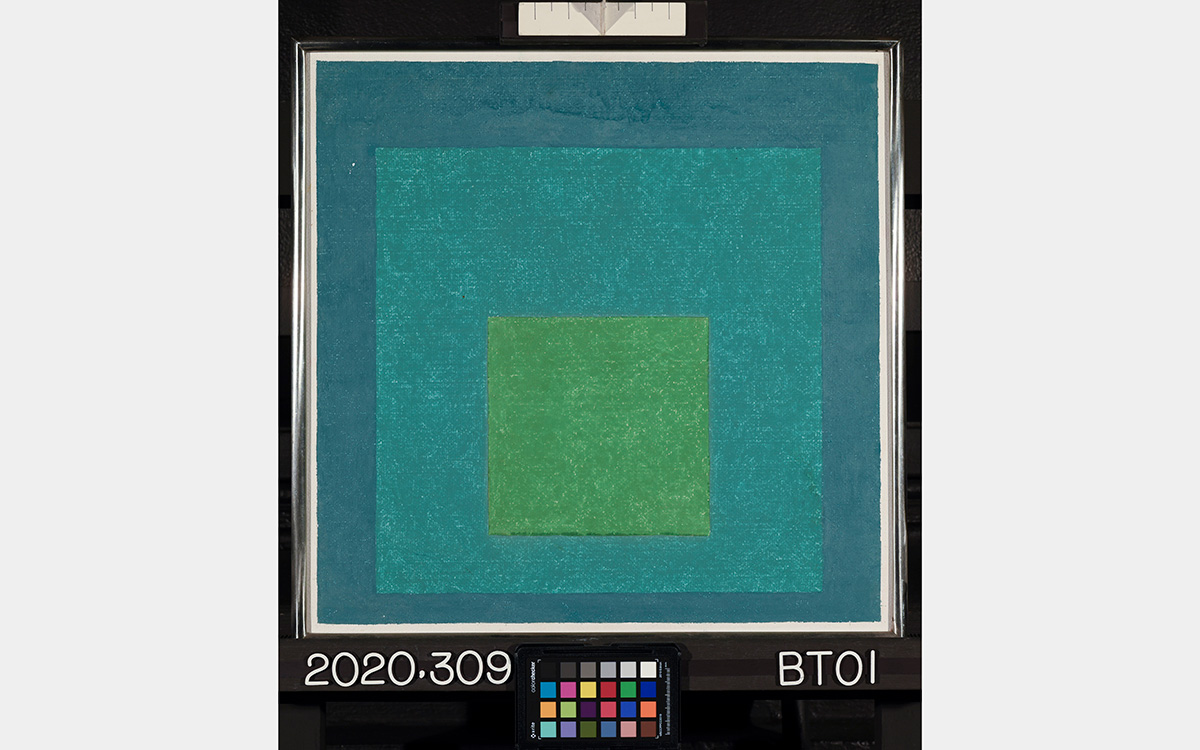
Josef Albers (American, 1888–1976) Study to Homage to the Square: From Inside, 1959, oil on Masonite, Alice F. and Harris K. Weston Collection of Post-World War II, Modern and Contemporary Art, 2020.309
Before treatment, normal light
This painting was slated for exhibition in an upcoming rotation of mid-twentieth century artworks from the Alice F. and Harris K. Weston of Post-World War II Modern and Contemporary Art Collection, and upon examination in storage we determined the surface would need treatment to address a fine layer of embedded surface grime, as well as retouching a small pigment loss on the outermost painted square.
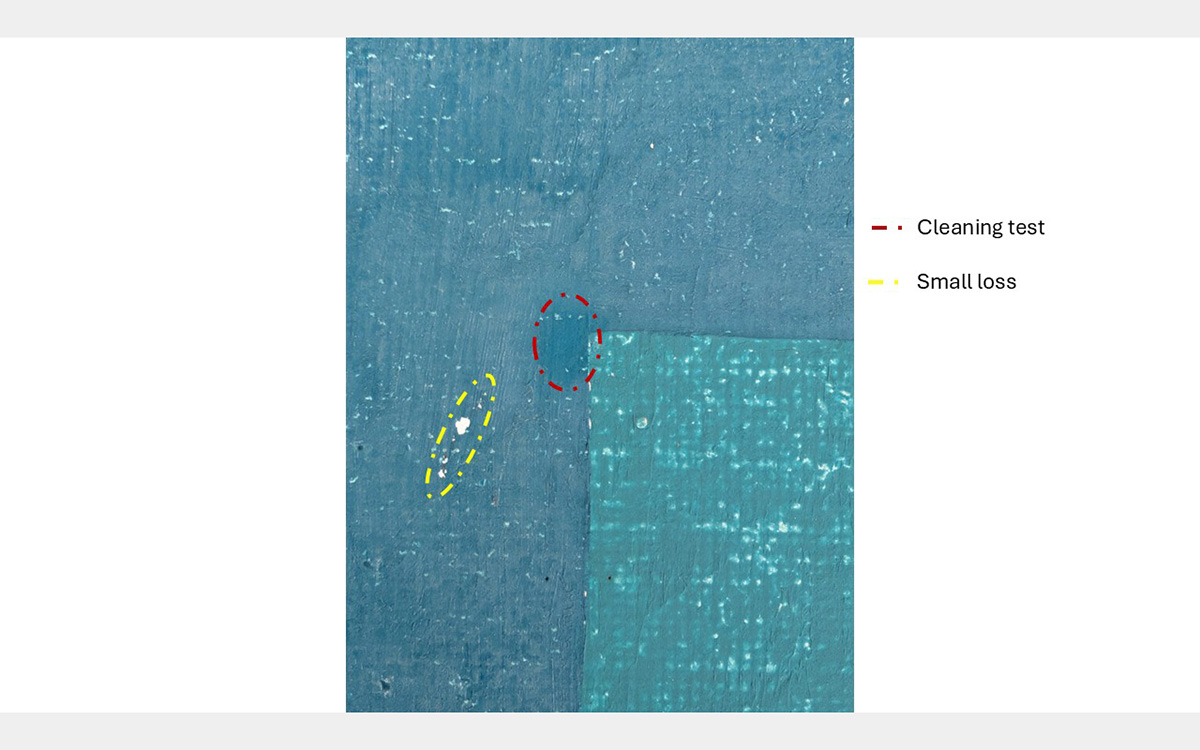
Josef Albers (American, 1888–1976) Study to Homage to the Square: From Inside (detail),1959, oil on Masonite, Alice F. and Harris K. Weston Collection of Post-World War II, Modern and Contemporary Art, 2020.309
Detail showing cleaning test and small paint loss
When the painting arrived in the conservation lab for treatment, I was delighted to confirm the painting’s verso contained not only the artist’s title, signature, and date, but also contained a complete list of all materials he used to create the image. Albers was known for keeping meticulous notes on materials he used to create his work (what an excellent practice!), and in the case of Homage to the Square/From Inside, he detailed the following on the back of the Masonite panel:
Ground:
- DuPont Flat White
- DuPont semigloss white alkyd enamel
(several coats of both)
Painting:
(paints used, from center)
- Emerald Green (Winsor & Newton)
- Cobalt Green (Winsor & Newton)
- Cobalt Green (Lefebvre)
Albers's note: “all in one primary coat and directly from the tube, no additional mixing, no additional painting medium”
Varnish:
- Methacrylate resin in xylene solvent
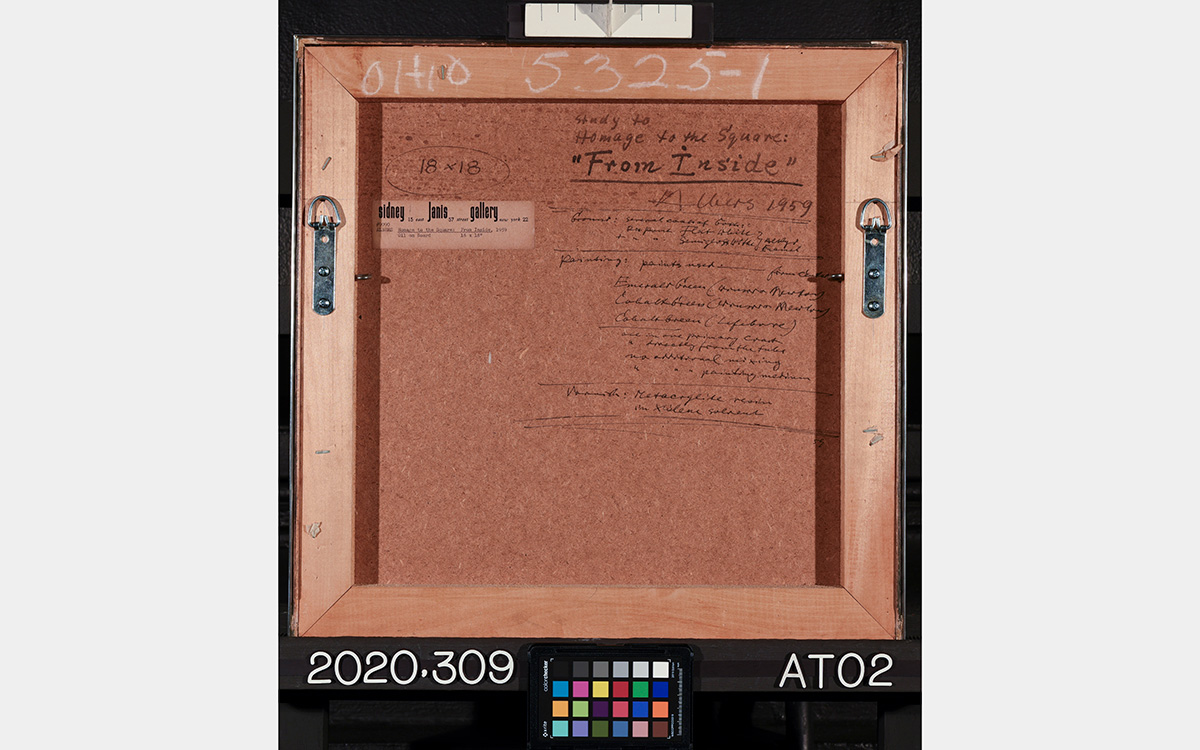
Josef Albers (American, 1888–1976) Study to Homage to the Square: From Inside (verso), 1959, oil on Masonite, Alice F. and Harris K. Weston Collection of Post-World War II, Modern and Contemporary Art, 2020.309
Verso, normal light
Albers was often interested in highlighting how the same colors could be visualized differently based on environment—from lighting and spatial relationships to the manufacturers themselves. Homage to the Square/From Inside is one of many examples where Albers utilized the same paint color twice, but due to the differences in manufacturing between Winsor & Newton and Lefebvre and the application methods Albers employed to create this composition, we as viewers see the same pigment as two slightly different colors.
As a conservator, this information is invaluable for my practice. I not only have a clear idea of what materials were used to make this painting—in this case, the excellent quality paints manufactured by Winsor & Newton and Lefebvre—but also now have a clear reference to exact pigments. This information made it much easier to color match during the retouching stage and gave me a better understanding of how the pigments will most likely continue to age over time.
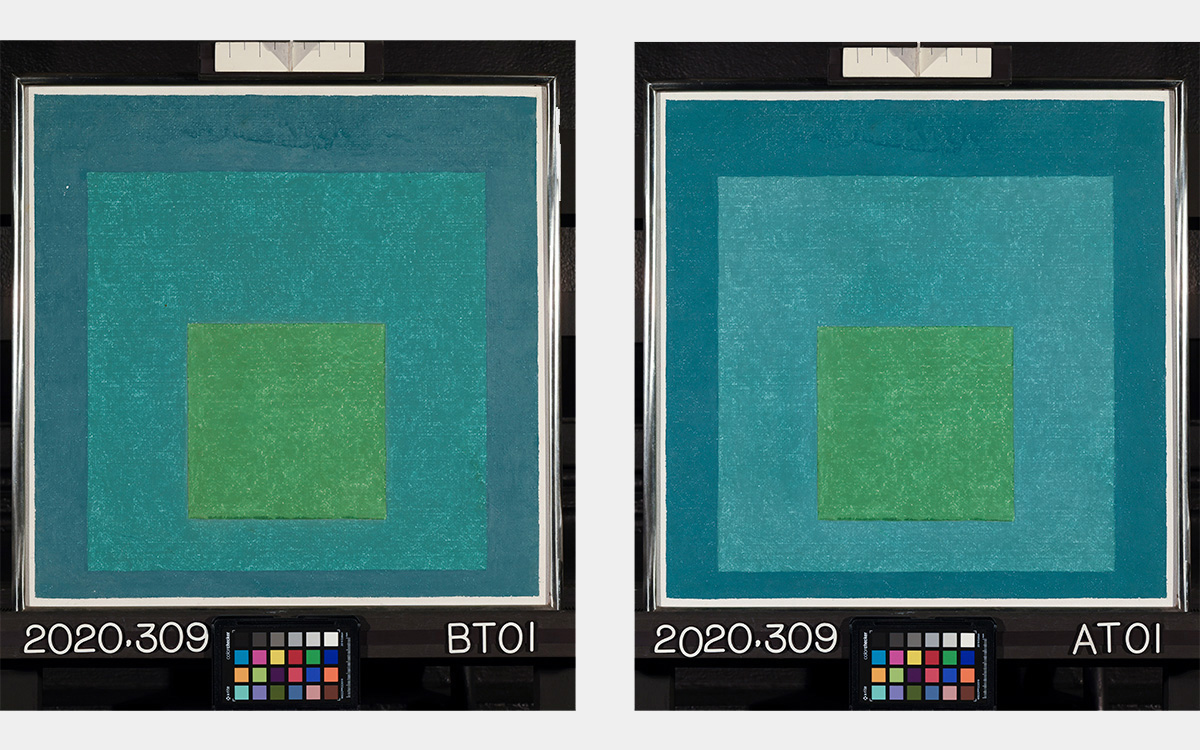
Josef Albers (American, 1888–1976) Study to Homage to the Square: From Inside, 1959, oil on Masonite, Alice F. and Harris K. Weston Collection of Post-World War II, Modern and Contemporary Art, 2020.309
Before and after, normal light
Before treatment (left, notice paint loss in upper left-hand corner) and after treatment (right)
Study to Homage to the Square/From Inside will be on view in Gallery 105 until February 9, 2026.
Related Blog Posts


Cincinnati, OH 45202
Toll Free: 1 (877) 472-4226
Museum Hours
Museum Shop
Terrace Café
Library
Cincinnati Art Museum is supported by the tens of thousands of people who give generously to the annual ArtsWave Campaign, the region's primary source for arts funding.

Free general admission to the Cincinnati Art Museum is made possible by a gift from the Rosenthal Family Foundation. Exhibition pricing may vary. Parking at the Cincinnati Art Museum is free.
Generous support for our extended Thursday hours is provided by Art Bridges Foundation’s Access for All program.

General operating support provided by: