Let it Snow
by Bruce Petrie, Chair, Board of Trustees
12/16/2025
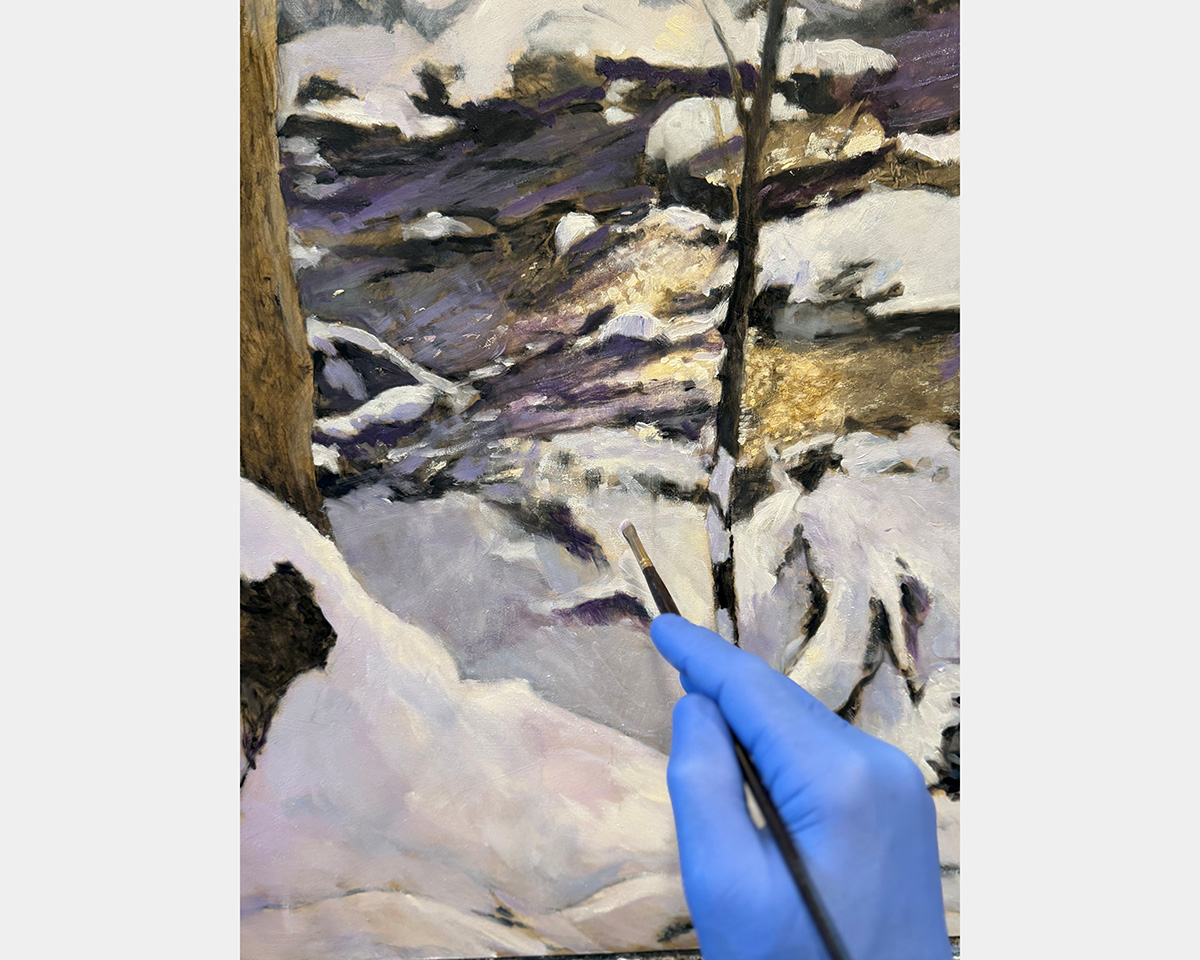
The author paints a winter scene.
A snowy day is a great time to enjoy a cozy visit to our Cincinnati Art Museum. Snow simultaneously brings out our practical and aesthetic sides. There’s the driveway to shovel, the screen time weather forecasts to watch. Snow can be annoying, right? But there’s also snow for snow’s sake, a visual experience. Snow, it turns out, is a pretty good art teacher. We can learn a thing or two from eyeing a good snowfall.
For example, a painter of snow learns there’s no such thing as white. Really? What about dreaming of a white Christmas and all that? Our paints, oil paints with pigments—as well as snow itself—reflect or absorb light in countless ways, none of which is actually the one and only thing we call white. When we look at snow, our brains see multitudes of reflections from individual ice crystals, acting like tiny mirrors. The more light hitting these reflective surfaces, the more we see a brightness bouncing off into a “whiteness” from all colors in the spectrum. On a sunny day, snow shadows read as violet because the shadow areas absorb light differently than the non-shadow areas.
Oil paints don’t have the benefit of tiny crystalline mirrors like real snow. They have, instead, pigments mixed with a binder of oil, such as linseed. The pigments have different chemical properties determining how they either reflect or absorb light waves; what we see as the paint color is the degree to which the pigment is reflecting or absorbing light. There are different types of fine art white oil paint with different chemistries. Titanium white is a very opaque white with high reflective properties. Other whites include zinc.
In art history the most infamous white has been lead white, otherwise known as flake white. Lead is poisonous when ingested. Back in the days before the dangers of lead paint were discovered, some artists probably ingested or absorbed dangerous amounts of lead from paint. Modern museum conservators take precautions whenever restoring an old painting originally painted with lead white.
Next time you visit the museum, you might keep on the lookout for the many different creative choices of pigments, realizing that there’s no such thing as a singular white in nature or in painting.
Related Blog Posts

Cincinnati, OH 45202
Toll Free: 1 (877) 472-4226
Museum Hours
Museum Shop
Terrace Café
Library
Cincinnati Art Museum is supported by the tens of thousands of people who give generously to the annual ArtsWave Campaign, the region's primary source for arts funding.

Free general admission to the Cincinnati Art Museum is made possible by a gift from the Rosenthal Family Foundation. Exhibition pricing may vary. Parking at the Cincinnati Art Museum is free.
Generous support for our extended Thursday hours is provided by Art Bridges Foundation’s Access for All program.

General operating support provided by: